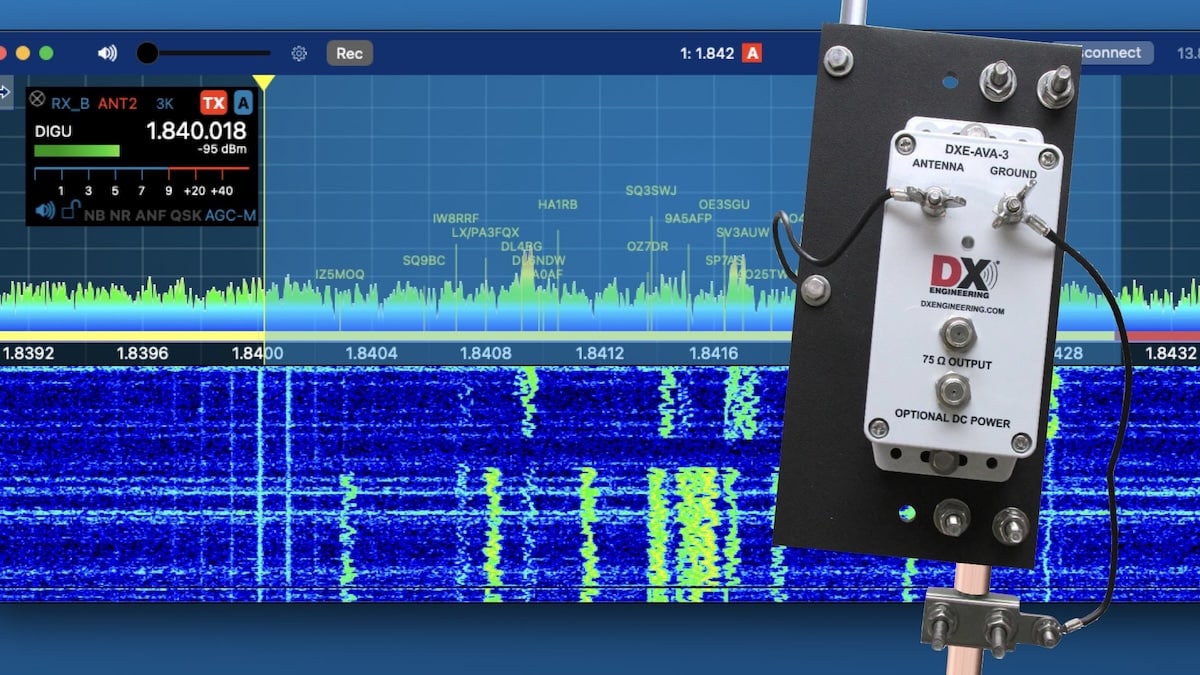
A dedicated receive antenna can transform what you hear. Short active verticals (SAVs) are compact, broadband, and purpose-built for low noise. Compared to using your large transmit antenna on receive, a small active vertical often delivers a clearly better signal-to-noise ratio (S/N)—which is what really matters for pulling weak signals out of the noise.
Why a Short Active Vertical for RX?
- Improved S/N vs. big TX antennas: SAVs are optimized for reception only and can be placed where they “hear” less noise and less coupling from your transmit system, towers, and radials.
- Broadband coverage: One antenna can cover LF/MF through HF for effortless band hopping, panoramic SDR work, and skimmers.
- Compact & easy to site: Minimal footprint with no high-power RF requirements makes them practical almost anywhere.
- Scales with band and location: In low-noise locations and on low bands like 160 m, receive performance can benefit from longer elements—up to ~6 m is often a sweet spot when paired with a suitable active matching unit.
Ideal Applications
1) Low-Band DXing
On 160/80 m, local noise and coupling from large station hardware can crush weak DX. A well-sited active vertical—especially with a slightly longer element (up to ~6 m where noise levels are low)—often yields audibly better S/N than your TX antenna on receive. The result: more copyable DX during marginal openings, dusk/dawn enhancements, and grayline events.
2) Contesting
A quiet RX vertical pays off two ways: lower noise for low-band runs and multiplier hunting, and as a superb SO2R or in-band multiplier receive antenna—clean, independent, and ready to dig weak callers out from under the pileup. Pairing your skimmer with a separate, broadband, low-noise antenna also boosts contest situational awareness.
3) Broadband HF Exploration with SDRs
SDR receivers shine with a flat, broadband, low-noise input. An active vertical lets you survey LF through HF without switching tuned antennas. Waterfalls look cleaner, weak beacons and utilities pop out, and you can monitor multiple bands/modes at once.
4) CW Skimmers
For skimmers, usable S/N is everything. A quiet RX vertical increases spot counts and improves decode quality across the band—ideal for contest prep, club nodes, and personal spotting networks.
5) Multi-Antenna Arrays
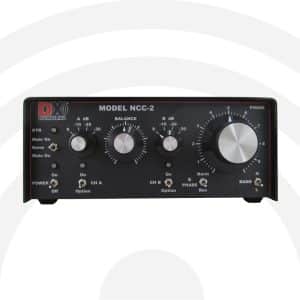
Two or more active verticals can be phased for steerable patterns and deep noise nulls. The NCC-2 Antenna Phasing System is a proven controller for building compact RX arrays that tame local noise and enhance directivity—perfect for serious low-band work.
Installation & Optimization Tips
Smart Siting
- Place the RX vertical away from towers, large metal, and house wiring to reduce re-radiated noise and coupling.
- Height is flexible on RX; experiment with element length. In low-noise locations and on bands like 160 m, lengths up to ~6 m can further improve results with the right active matching unit.
Coax & Common Noise Control
- Use high-quality coax (bury if possible): Good coaxial shielding helps; if possible, bury coax cable to reduce pickup of household and neighborhood noise.
- Choke both ends: Fit two common-mode chokes—one at the antenna/matching unit and another at the radio end—to block noise currents on the outside of the shield.
- Turn-key option: RX Common Mode Choke (ready-made, HF-optimized).
- DIY recipe (FT-240-31): Stack two FT-240-31 ferrite cores. Wind 8–12 tight, evenly spaced turns of flexible 50 Ω coax (e.g., RG-316, RG-142, or RG-58 if diameter allows) through the stacked cores. Aim for several kΩ of choking impedance across the HF spectrum. Install one choke at the antenna and one at the shack entrance/radio.
Powering & Grounding
- Follow the active unit’s bias-tee and grounding guidance. Keep DC injection and coax runs tidy to avoid introducing noise.
Gain Management (AVA-3)
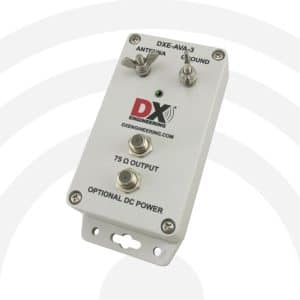
- The AVA-3 Active Matching Unit provides three presettable gain levels to suit element length and local noise conditions.
- Set gain so that band noise is just perceptible above the receiver’s own noise floor. You want enough gain to reveal atmospheric/band noise without overdriving the radio or highlighting local hash. More gain does not improve S/N.
Strong-Signal Hygiene
- If you live near high-power AM/shortwave sites, consider additional front-end filtering to prevent overload. Active verticals generally handle strong signals well, but good practice matters.
Recommended Options
Turn-Key: DX Engineering RSEAV-1 RX Active Vertical Antenna
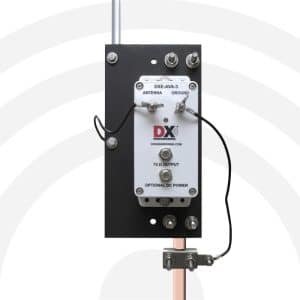
DX Engineering RSEAV-1 is a complete receive-only vertical system with an element of approximately 2.6 m. It includes the AVA-3 electronics, giving you the same three presettable gain levels to tailor performance to your element length and local noise environment. Ideal if you want proven, broadband, low-noise performance without the DIY detours.
Builder’s Path: DX Engineering AVA-3 Active Matching Unit
Prefer to make your own element (including longer lengths—up to ~6 m can be advantageous on low bands in quiet locations)? Start with the DX Engineering AVA-3. It buffers the high-impedance short (or modest-length) vertical element and offers three presettable gain levels. Adjust gain so band noise is just audible above the radio’s internal noise—then enjoy a cleaner waterfall and more copyable weak signals.
Arrays & Phasing: NCC-2 Antenna Phasing System
For directional noise nulls and steerable receive patterns using two active verticals, consider the NCC-2 Antenna Phasing System. It’s a practical way to elevate a quiet single element into a powerful low-band listening array. It can also be used to phase a short active vertical with your transmit antenna for improved S/N.
Noise Control Essentials: RX Common-Mode Chokes
Don’t forget chokes. Use two: one right at the antenna/matching unit and one at the shack end. Grab the ready-made, HF-optimized RX Common Mode Choke, or build your own with stacked FT-240-31 cores and 8–12 turns of suitable coax. If possible, bury the coax to further reduce noise pickup.
Wrap-Up: Hear More, Work More
Short active vertical RX antennas deliver what counts: quieter backgrounds and stronger, more intelligible signals—especially on challenging low bands. Whether your passion is low-band DXing, fast-paced contesting (including SO2R and in-band mult hunting), SDR-based exploration, or running your own CW skimmer, a dedicated RX vertical is a high-impact upgrade.
Ready to level up your station? Choose the turnkey RSEAV-1 for an easy, proven solution—or build your own with the AVA-3 and a custom element. Add two RX common-mode chokes and, if possible, bury the coax. Your ears—and your logbook—will notice the difference.